
Advanced Life Support from Excelsior Ambulance Service
Quick Links
Who Crews an ALS Ambulance?
An Excelsior ALS ambulance is staffed by at least one paramedic licensed in the state of operation, along with EMTs who provide Advanced Life Support within their approved scope of practice. ALS crews are prepared to assess higher-acuity patients, monitor changes in their condition, establish IV access, administer approved medications, provide cardiac monitoring, manage airway needs, and respond to changes in a patient’s condition during transport.
The crew’s role begins before transport. They review the patient’s condition, confirm the transport plan, and prepare the equipment required for the requested level of care. During transport, they provide ongoing assessment and treatment based on the patient’s needs.
ALS crews may care for patients experiencing chest pain, respiratory distress, seizures, altered mental status, pain requiring medication management, or other conditions that require closer monitoring than Basic Life Support (BLS) can provide.
What Advanced In-Field Clinical Capabilities Can Excelsior ALS Provide?
Excelsior’s advanced in-field clinical capabilities may include IV access, medication administration, cardiac monitoring, oxygen therapy, and advanced airway management within the appropriate clinical scope. Excelsior also provides capabilities that set its EMS model apart, including IV antibiotic administration and laboratory specimen collection in the field.
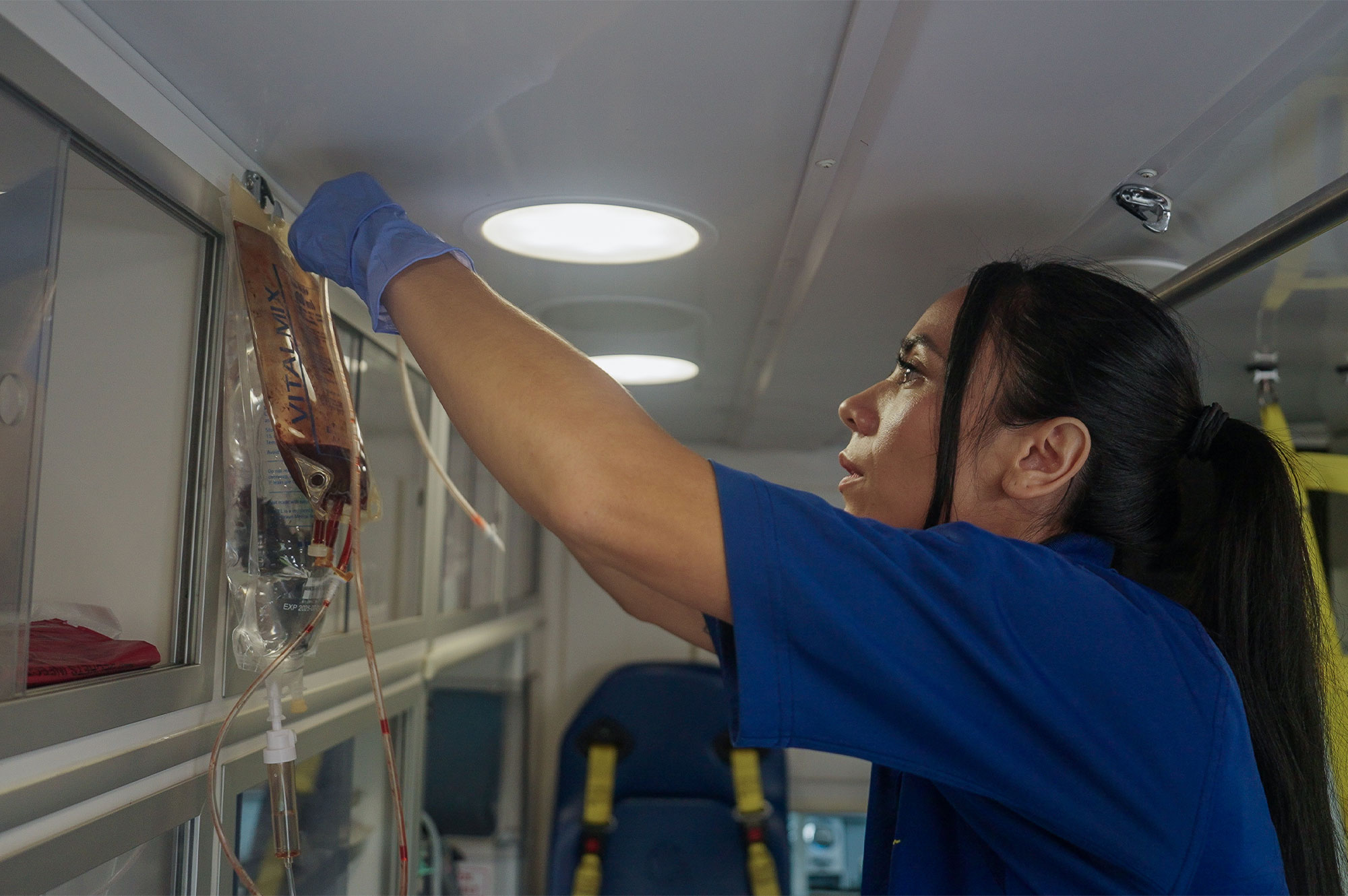
Additional capabilities are part of Excelsior’s progressive clinical direction, including blood products on ambulances (in development) and point-of-care ultrasound (POCUS) for heart attacks and trauma (in development). These capabilities reflect a system built around clinical excellence rather than transportation alone.
Excelsior ALS is built around advanced clinical capabilities in the field. These capabilities help support patients who need more than Basic Life Support (BLS) during emergency response, interfacility transport, or non-emergency ambulance transport.
For health care partners, this matters because a stronger ALS program gives patients access to the appropriate level of care before they reach the next facility.

What Rural ALS Treatment Options Does Excelsior Specialize In?
One of Excelsior’s key differentiators is High-Flow Nasal Cannula (HFNC) support in rural areas across the region. Excelsior utilizes the Hamilton T1, one of the most technologically advanced transport ventilators available. This capability helps support patients with complex respiratory needs when Basic Life Support (BLS)-level oxygen therapy is not sufficient and air transport is not the appropriate option.
Excelsior specializes in rural ALS support for patients who need advanced care outside major metropolitan areas. Rural transport often presents unique clinical and operational challenges. Transport distances can be longer, access to specialty facilities may be limited, and the appropriate level of EMS support may not always be readily available.
Excelsior also supports rural ALS through paramedic-level care, IV access, medication administration, cardiac monitoring, and coordinated interfacility transport. This gives hospitals and health care teams a stronger option for transporting higher-acuity patients who need advanced clinical capabilities during transport.

How Do Excelsior ALS Ambulances Provide a Medevac Alternative?
Excelsior ALS ambulances provide an air medical transport alternative when a patient requires a higher level of ground transport and air transport is unavailable, inappropriate, or not the best clinical option. This is not a fallback service. Excelsior provides the same advanced level of care as traditional medevac services, delivered safely and efficiently through ground transport. In many cases, advanced ground transport gives health care teams the support they need while keeping patients in a controlled EMS environment.
An ALS ambulance may be appropriate when weather, distance, patient condition, facility access, or transport timing makes air transport difficult. ALS crews can support patients who require paramedic-level monitoring, medication administration, respiratory care, or cardiac monitoring during transport.
Excelsior’s model is built for high-acuity and specialty transports across the Southeast. For rural hospitals and discharge teams, this provides access to advanced ground transport capabilities when air transport is not the appropriate choice.
What Makes Excelsior the Best ALS Option for the Southeast?
Excelsior ALS combines paramedic-level care with a system-focused EMS model for health care partners across the Southeast. Advanced Life Support depends on highly trained clinicians, the appropriate equipment, and the ability to respond to higher-acuity patient needs during transport.
Excelsior brings together advanced clinical capabilities, high-performance operations, and elite EMS and specialty transport across the Southeast. The ALS program is supported by in-field capabilities such as IV antibiotic administration, laboratory specimen collection in the field, and High-Flow Nasal Cannula (HFNC) support in rural areas. Ongoing development of blood product transport and point-of-care ultrasound (POCUS) also reflects Excelsior’s progressive approach to pre-hospital care.
Excelsior ALS provides a stronger option for emergency response and complex ground transport for hospitals, discharge planners, and case managers.
To coordinate ALS coverage, recurring transport needs, or system-level EMS support, contact Excelsior Ambulance Service today.

Excelsior Advanced Life Support – FAQs
What does Advanced Life Support mean in ambulance transport?
Advanced Life Support refers to paramedic-level care provided before or during ambulance transport. ALS may include IV access, medication administration, cardiac monitoring, advanced airway support, oxygen therapy, and treatment for more serious medical emergencies. ALS is used when a patient’s condition requires more clinical support than Basic Life Support can provide.
What is the difference between BLS and ALS?
BLS provides essential EMS care such as assessment, oxygen support, CPR, AED use, bleeding control, and safe movement. ALS provides a higher level of care through paramedic-level interventions. This may include IV medications, cardiac monitoring, advanced airway management, and more complex assessment. ALS is generally used when the patient’s condition is more acute or may change during transport.
When should a hospital request ALS instead of BLS?
A hospital may request ALS when a patient requires cardiac monitoring, IV medication administration, advanced airway management, respiratory support, or paramedic-level assessment during transport. ALS may also be appropriate when a patient is stable enough for transport but has a condition that could worsen before arrival. When the appropriate level of care is unclear, coordination with the EMS team can help determine the most appropriate mode of transport.
Can ALS ambulances be used for interfacility transfers?
Yes. ALS ambulances are often used for interfacility transfers when a patient needs a higher level of care between health care settings. This may include transport from a smaller hospital to a specialty facility, movement between hospital campuses, or transfer to a partner facility. ALS helps maintain continuity of clinical care during the transition between the sending and receiving teams.
Does ALS include respiratory support?
Yes. ALS can include respiratory support within the approved clinical scope of practice. This may involve oxygen therapy, advanced airway management, medication administration, or other interventions based on the patient’s condition and applicable protocols. Excelsior also specializes in High-Flow Nasal Cannula (HFNC) support in rural areas, helping care for patients with more complex respiratory needs when appropriate.
Is ALS the same as critical care transport?
No. ALS and critical care transport are different levels of ambulance service. ALS provides paramedic-level care for patients who need advanced support but may not require the highest level of transport medicine. Critical care transport is designed for patients who need more intensive monitoring or interventions, such as ventilator management or multiple medication infusions.