
911 Emergency Response
Quick Links
- How Has Excelsior Handled 911 Emergency Response Situations In The Past?
- How Does Excelsior Provide System-Level Solutions For Hospitals During 911 Emergency Response Calls?
- How Is Excelsior Different From Other 911 Emergency Response Providers In The Southeast?
- What Makes Excelsior Best Equipped To Handle Rural 911 Emergency Response Calls?
- What Is The 911 Emergency Response Range For Excelsior?
- What Makes Excelsior The Best Choice For 911 Emergency Response In The Southeast?
- 911 Emergency Response FAQs
How Has Excelsior Handled 911 Emergency Response Situations in the Past?
Excelsior has demonstrated its 911 emergency response capability during high-pressure events where healthcare systems needed more than basic unit availability. This kind of reaction was clearly displayed when responding to the Ft. Stewart shooting.
When the Ft. Stewart shooting occurred, multiple EMS services responded. Other responding services arrived at the hospital and found Excelsior already there, handling the situation. Hospital staff ultimately decided the extra help wouldn’t be necessary and turned them away.
In a crisis, hospitals need crews that can manage high-acuity needs, coordinate movement, communicate clearly, and support emergency operations without adding confusion. Excelsior’s response model is built around that level of clinical excellence and advanced preparation. For hospitals and health groups, that kind of performance matters when emergency response becomes a system-wide event.
How Does Excelsior Provide System-Level Solutions for Hospitals During 911 Emergency Response Calls?
Excelsior provides system-level solutions during 911 emergency response by supporting the connection between the field, the hospital, and the next clinical decision. Emergency response does not end when a unit arrives on scene. It continues through assessment, stabilization, communication, transport decisions, and hospital handoff.
For hospitals and health groups, Excelsior’s 911 emergency response model can help support:
- Emergency department readiness through clear pre-arrival communication
- High-acuity response when calls involve respiratory, cardiac, trauma, or complex medical needs
- Rural response where advanced care may need to begin before hospital arrival
- Surge and crisis support when call volume increases suddenly
- Coordination with receiving teams during critical transport decisions
- Appropriate escalation into ALS, CCT, or specialty transport when needed
Advanced equipment also plays a role. Excelsior prioritizes equipment that enables higher-level care, not just transport. This supports crews in being better prepared when a 911 call becomes a complex clinical event.

How Is Excelsior Different from Other 911 Emergency Response Providers in the Southeast?
Excelsior is different because it is not built around minimum response capability. The organization invests in people, equipment, training, and advanced field medicine because better preparation changes what can happen before arrival at the hospital.
Excelsior operates in a rapidly consolidating EMS market. Larger corporate organizations are acquiring competing EMS services and optimizing operations for profitability. Excelsior operates differently: we invest in our team and equipment because that is how lives are saved. If a $1,000 piece of equipment helps save even one life, Excelsior believes it belongs in the system.

What Makes Excelsior Best Equipped to Handle Rural 911 Emergency Response Calls?
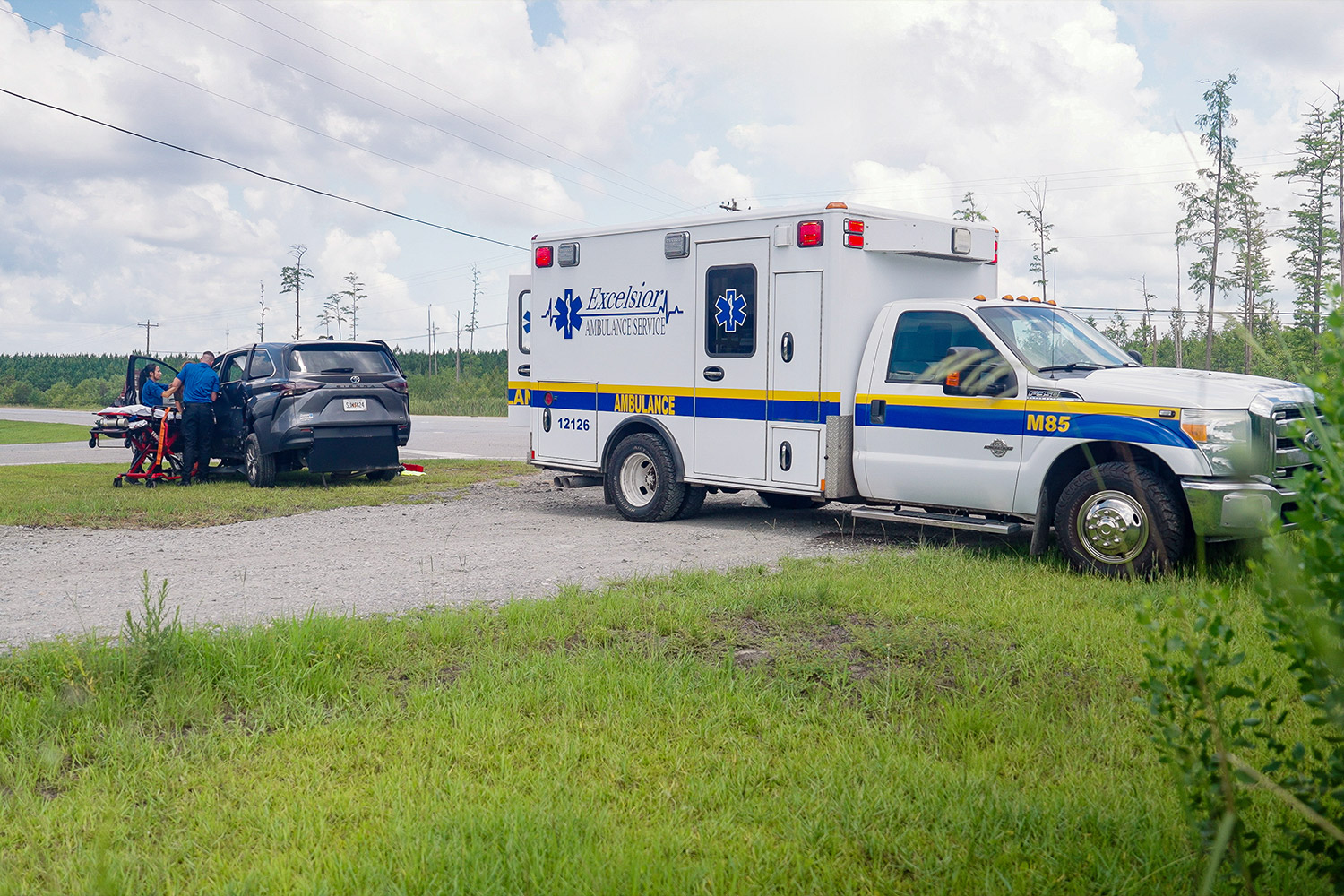
Rural 911 emergency response requires greater clinical capability in the field because access to specialty resources may be farther away. Longer distances, limited nearby specialty care, and fewer available advanced units can make the first EMS response even more important.
Excelsior is the first rural market provider to offer High-Flow Nasal Cannula (HFNC) across the region. While other HFNC-capable providers often operate in metro markets, Excelsior brings this advanced respiratory support capability to rural areas where the gap is more significant.
Excelsior also brings advanced clinical capability to rural response through field-based tools and protocols that support higher-acuity care. IV antibiotics, field-drawn lab samples, blood products (currently in development), and POCUS (currently in development) all reflect a model focused on bringing more capability closer to the emergency. Excelsior helps close the gap between the emergency scene, the local facility, and the next level of care.
What Is the 911 Emergency Response Range for Excelsior?
Excelsior provides EMS coverage across a multi-state footprint in the Southeast, including Georgia, Alabama, South Carolina, and Florida. The goal is to provide regional reach for healthcare partners that need a response partner with broader operational depth.
Multi-state coverage opens up options for healthcare systems operating across multiple markets. A single hospital may need emergency response support in one region, while a health system may need consistent service expectations across several facilities or communities. Excelsior can support both.
The value is not only geographic but also operational. Excelsior brings the same focus on equipment readiness, clinical training, and response standards across its coverage area. That consistency helps healthcare organizations work with a partner that understands emergency response, interfacility transfers, high-acuity transport, event coverage, and specialty EMS needs across the Southeast.
What Makes Excelsior the Best Choice For 911 Emergency Response in the Southeast?
Excelsior is built for healthcare systems that require more from EMS. Its 911 emergency response model combines high-performance operations, advanced clinical capability, and high-acuity and specialty transports across the Southeast.
Excelsior brings HFNC capability into rural markets, supports advanced in-field care, invests in progressive equipment, and operates across Georgia, Alabama, South Carolina, and Florida. The organization also has a proven record of clinical advancement, including being first in Georgia to receive PLS licensure before COVID-19.
For hospitals and health groups, Excelsior offers more than emergency response capacity. It offers a system partner with the training, equipment, and field capability to support complex calls. For EMTs and medics, it offers a clinical environment where advanced preparation is taken seriously.
To discuss 911 emergency response coverage, system-level EMS support, or high-acuity response needs across the Southeast, contact Excelsior Ambulance Service today.

911 Emergency Response – FAQs
How can hospitals evaluate whether a 911 EMS partner is ready for high-acuity response?
Hospitals can evaluate a 911 EMS partner by assessing clinical scope, equipment readiness, field capabilities, training infrastructure, and performance during complex incidents. A stronger partner should be prepared for respiratory emergencies, cardiac concerns, trauma response, medication needs, and rapid escalation when a call becomes more complex. Excelsior supports this through advanced in-field capabilities, HFNC in rural areas, progressive equipment, and a system-focused EMS model.
Why does rural HFNC capability matter for emergency response planning?
Rural HFNC capability matters because respiratory emergencies may occur far from metro-level specialty resources. When HFNC is available in rural markets, advanced respiratory support can begin earlier in the response and transport process. This gives hospitals and health systems a stronger option when respiratory patients need more than conventional oxygen support before reaching the next care setting.
What advanced field capabilities should health systems look for in a 911 EMS partner?
Health systems should look for capabilities that support care before hospital arrival, not only transportation. This may include IV access, medication administration, cardiac monitoring, respiratory support, field-drawn lab samples, IV antibiotics, ventilator-capable care, and future capabilities such as POCUS and blood products. Excelsior’s model is built around expanding what EMS can do in the field when clinical need demands more.
How does multi-state EMS coverage help larger health groups?
Multi-state EMS coverage helps larger health groups by creating more consistent expectations across different markets. Health systems that operate in more than one region may need an EMS partner that understands multiple service areas, staffing needs, operational standards, and facility relationships. Excelsior’s coverage across Georgia, Alabama, South Carolina, and Florida supports such regional coordination.
Why would EMTs and medics choose Excelsior for 911 emergency response work?
EMTs and medics may choose Excelsior because the environment supports clinical growth, the use of advanced equipment, and meaningful field experience. 911 emergency response can involve fast decisions, complex scenes, respiratory emergencies, trauma, and high-acuity handoffs. Excelsior’s investment in training, equipment, and advanced capabilities gives clinicians a stronger environment to build skills and confidence.
How does equipment investment affect the quality of 911 emergency response?
Equipment investment affects the quality of 911 emergency response because crews can only perform at the level their tools and training allow. Excelsior’s philosophy is to invest in equipment when it can improve care, even when that means carrying more than many larger organizations. This approach supports readiness for complex calls and helps crews respond with the resources needed for high-acuity situations.